Download Splunk Certified Cybersecurity Defense Architect.SPLK-5003.DeepDumps.2026-10-19.36q.vcex
| Vendor: | Splunk |
| Exam Code: | SPLK-5003 |
| Exam Name: | Splunk Certified Cybersecurity Defense Architect |
| Date: | Oct 19, 2026 |
| File Size: | 406 KB |
How to open VCEX files?
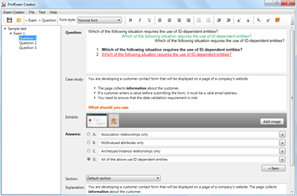
Files with VCEX extension can be opened by ProfExam Simulator.
Discount: 20%

Demo Questions
Question 1
Sophia manages data ingestion for her organization’s SIEM. The data science team wants to perform real-time analytics on security data and asks Sophia for a copy of all new endpoint telemetry from the current point forward.
The SIEM currently collects 15TB of endpoint telemetry every day.
Which of the following solutions can Sophia use to best help the data science team?
- Export the last 12 months of telemetry data from the SIEM in OCSF.
- Use a message bus to send data to both the SIEM and data science team.
- Export the last 12 months of telemetry data from the SIEM in JSON format.
- Configure the SIEM to export a CSV report of all new telemetry data every night.
Correct answer: B
Explanation:
Technical JustificationCorrect Option (B): Use a message bus to send data to both the SIEM and data science team.This is the only architecture that satisfies the requirement for real-time analytics on current and future data ("from the current point forward") at a 15TB/day volume. A message bus (e.g., Apache Kafka, AWS Kinesis, Splunk HTTP Event Collector with acknowledgment, or a Syslog/TCP forwarding tier) implements a fan-out (publish/subscribe) pattern. This decouples ingestion from consumption, allowing the SIEM to index data for correlation/retention while simultaneously streaming raw events to a downstream analytics platform (e.g., Spark, Flink, or a Data Lake) with low latency and high throughput. It prevents backpressure on the SIEM indexers and eliminates the overhead of repeated bulk exports.Option A (Export last 12 months in OCS) & Option C (Export last 12 months in JSON):Both options fail the "current point forward" requirement by focusing on historical backfill (12 months ≈ 5.4 PB). Exporting petabytes of historical data is an offline, batch-oriented ETL operation unsuitable for real-time streaming. Furthermore, OCS (Optimized Columnar Store) and JSON are serialization formats; the transport mechanism remains a bulk extract, inducing massive I/O contention on the SIEM storage tier and failing to provide the continuous data feed the data science team requires.Option D (Nightly CSV report export):This introduces a 24-hour latency, violating the "real-time" requirement. CSV is a row-based, non-splittable format with high parsing overhead and no schema enforcement, making it inefficient for 15TB/day analytics pipelines. Scheduled bulk exports create "thundering herd" resource spikes on the SIEM search heads/indexers nightly, impacting concurrent search performance and SLA adherence for security operations.References1. Splunk Documentation - Forward data to third-party systems (covers syslog/TCP/HEC fan-out architectures for real-time data duplication): https://docs.splunk.com/Documentation/Splunk/latest/Forwarding/Forwarddatatothird-partysystemsd2. Apache Kafka Documentation - Kafka Connect Splunk Sink/Source Connectors & Architecture Patterns (industry standard for high-throughput message bus integration with SIEMs): https://kafka.apache.org/documentation/#connect
Question 2
To ensure leadership is aware of the security team’s performance, which measurements should be presented on a regular basis? (Choose all that apply.)
- Patch compliance percentage
- Mean time to contain
- Number of emergency change requests
- Mean time to respond
Correct answer: A, B, D
Explanation:
Technical JustificationPatch compliance percentage: This is a critical Key Performance Indicator (KPI) for vulnerability management hygiene. It provides leadership with a quantifiable measure of the organization’s attack surface reduction and adherence to configuration baselines. Consistent reporting demonstrates the program's effectiveness in reducing exploitable vulnerabilities before they can be leveraged by adversaries.Mean time to contain (MTTC): This metric measures the duration between the detection of an incident and the implementation of effective containment actions. It is a primary indicator of the Security Operations Center’s (SOC) operational maturity and the efficacy of playbooks and automation. Leadership requires this to assess residual risk exposure during active incidents.Mean time to respond (MTTR): Often distinguished from containment as the time to fully remediate and recover, this metric reflects the end-to-end efficiency of the detection, analysis, and remediation lifecycle. It validates the integration between detection engineering, threat intelligence, and IT operations, providing leadership visibility into the team's ability to restore business continuity.Why C is less suitable:Number of emergency change requests is primarily an IT Service Management (ITSM) and Change Advisory Board (CAB) metric. While security incidents may trigger emergency changes (e.g., emergency patching), the volume of emergency changes is not a direct measurement of security team performance. It reflects operational instability or patch management velocity within IT operations, not the efficacy of security detection, response, or vulnerability management capabilities. Presenting this as a security KPI conflates operational hygiene with security outcomes.References1. NIST Special Publication 800-55 Revision 1: Performance Measurement Guide for Information2. Splunk: The State of Security 2024 - Key Metrics for Measuring SOC Performance Security (https://csrc.nist.gov/publications/detail/sp/800-55/rev-1/final) (https://www.splunk.com/en_us/blog/security/state-of-security-2024-key-metrics-soc-performance.html)
Question 3
Justin has just finished successfully importing data from the CMDB platform into the SIEM. While validating data, he discovers a host with a MAC address (35:33:33:20:76) that does not have the same OUI (03:83:71) as the rest of the deployed devices.
Which of the following is the most likely explanation for this discrepancy?
- CMDB contains data from personal devices managed under MDM
- CMDB data was normalized during the SIEM import process
- CMDB data was corrupted during the export process
- CMDB contains data related to dynamic VPN pool addresses
Correct answer: A
Explanation:
Justification for Correct Answer (A):The discrepancy is best explained by MAC Address Randomization on personal devices managed via MDM. Modern operating systems (iOS 14+, Android 10+, Windows 10/11) enable MAC randomization by default for Wi-Fi scanning and association to prevent tracking. These randomized addresses are Locally Administered Addresses (LAA), identified by the Universal/Local (U/L) bit (bit 1 of the first octet) set to 1. The observed MAC 35:33:33:20:76 (first octet 0x35 = 00110101 binary) has the U/L bit set to 1, confirming it is a locally administered, randomized address. Since the CMDB ingests data from MDM solutions managing BYOD/personal devices, these privacy MACs appear alongside corporate assets with burned-in addresses (BIA) sharing the organizational OUI (03:83:71).Why Other Options Are Less Suitable:CMDB data was normalized during the SIEM import process: Normalization standardizes field names and formats (e.g., parsing timestamps, mapping vendor fields to CIM); it does not alter the underlying Layer 2 hardware identifiers like MAC addresses or OUIs.CMDB data was corrupted during the export process: Data corruption typically results in malformed syntax (invalid hex characters, truncated fields) or checksum failures, not a syntactically valid MAC address conforming to IEEE 802 standards for Locally Administered Addresses.CMDB contains data related to dynamic VPN pool addresses: VPN pools allocate Layer 3 IP addresses to virtual tunnel interfaces (e.g., TUN/TAP adapters). They do not assign or influence the physical/hardware MAC address (Layer 2) of the endpoint recorded in the CMDB.References:1. IEEE Standards Association - MAC Address Registration Authority (OUI) Tutorial:https://standards.ieee.org/develop/regauth/tut/oui.html2. NIST Special Publication 800-124 Rev. 1 - Guidelines for Managing the Security of Mobile Devices in the Enterprise (Section 3.3.2 MAC Address Randomization):https://csrc.nist.gov/publications/detail/sp/800-124/rev-1/final
Question 4
Which of the following are common criteria used for the evaluation of threat intelligence feeds? (Choose all that apply.)
- TLP
- Industry
- Source
- Severity
Correct answer: A, B, C, D
Explanation:
All four options represent standard evaluation criteria used to assess the quality, relevance, and operational utility of threat intelligence feeds within a Security Operations Center (SOC) or Threat Intelligence Platform (TIP).TLP (Traffic Light Protocol): TLP is a critical handling criterion. Evaluating a feed requires understanding the TLP designation (Red, Amber, Green, Clear) attached to its indicators to ensure compliance with sharing restrictions, legal obligations, and internal dissemination policies. Feeds with overly restrictive TLP markings (e.g., TLP:Red) may have limited operational utility for automated blocking or broad team sharing.Industry: Sector relevance is a primary filter for feed selection. Threat actors, TTPs, and targeting patterns vary significantly by vertical (e.g., financial services vs. healthcare vs. energy). Evaluating a feed’s industry focus ensures the intelligence aligns with the organization’s specific threat landscape and regulatory requirements (e.g., FS-ISAC for finance, H-ISAC for health).Source: Source credibility and reliability are foundational to the intelligence lifecycle (e.g., the Admiralty Code). Evaluation involves assessing the provider’s reputation (commercial vendor, ISAC/ISAO, open source, government CERT, internal hunting), historical accuracy, false positive rates, and collection methodologies (technical sensors vs. human intelligence).Severity: Severity scoring (often CVSS for vulnerabilities or custom risk scores for observables) is essential for prioritization and automation. Feeds must be evaluated on how they score severity, whether that scoring aligns with the organization's risk appetite, and if it supports automated tiering in SIEM/SOAR workflows (e.g., auto-blocking only "Critical/High" indicators).References1. NIST Special Publication 800-150: Guide to Cyber Threat Information Sharing (Section 3.2"Information Source Evaluation" and Section 4 "Handling and Sharing") - https://csrc.nist.gov/publications/detail/sp/800-150/final2. FIRST.org - Traffic Light Protocol (TLP) Standard Definitions and Usage Guidance - https://www.first.org/tlp/
Question 5
Which MLTK command can be combined with tstats in an ES detection to apply a machine learning model to search results?
- Summary
- Fit
- Cluster
- Sample
Correct answer: B
Explanation:
Justification for Correct Answer: B. fitThe fit command is the operative MLTK command used to apply a pre-trained model to incoming search results to generate predictions, anomaly scores, or classifications. In the context of an Enterprise Security (ES) detection, tstats is typically leveraged for high-performance retrieval of accelerated data model summaries (e.g., Authentication, Network_Traffic). The pipeline | tstats ... | fit <model_name> ... allows the detection logic to enrich these summarized events with machine learning inference results (e.g., Is_Anomalous, predicted_field) in real-time or scheduled searches. This operationalizes the model trained during the development phase (via fit ... into <model_name>) for production alerting.Why Other Options Are Incorrect:summary: This command (or summarize) is used for exploratory data analysis (EDA) to generate statistical descriptions (count, mean, stddev, quartiles) of fields. It does not possess the capability to load a persisted model artifact (*.pkl) or perform inference on data streams.cluster: This is an unsupervised learning command used to group similar events dynamically at search time (e.g., k-means, DBSCAN). It does not apply a pre-trained, supervised, or pre-fitted model; rather, it computes clusters ad-hoc, which is computationally expensive and unsuitable for low-latency ES detections against tstats output.sample: This command performs statistical sampling (e.g., sample ratio=0.1) to reduce dataset volume for analysis or training efficiency. It has no machine learning inference capabilities and cannot apply a model to data.References1. Splunk Machine Learning Toolkit (MLTK) - fit command documentation:https://docs.splunk.com/Documentation/MLApp/latest/User/Fit2. Splunk Enterprise Security - Creating correlation searches with tstats and MLTK:https://docs.splunk.com/Documentation/ES/latest/Admin/Createmanagedcorrelationsearches(See sections on "Data model acceleration" and "Advanced correlation search syntax" for MLTK integration patterns).
Question 6
An architect is planning for a net new SIEM deployment.
Which of the following data sources will provide the most immediate security value?
- Physical access control logs
- Active Directory logs
- CMDB logs
- Security tool alerts
Correct answer: D
Explanation:
Justification for Correct Answer: D. Security tool alertsImmediate Actionability and Context: Security tool alerts (e.g., EDR, NDR, WAF, IDS/IPS, Email Security) represent pre-correlated, high-fidelity detections generated by specialized engines. Ingesting these provides immediate visibility into active threats and known malicious behavior without requiring the SIEM to first baseline normal behavior or build complex correlation rules from raw logs.Reduced Time-to-Value (TTV): These sources enable Day 1 operational use cases—alert aggregation, deduplication, enrichment, and single-pane-of-glass triage. The SOC can immediately reduce alert fatigue by centralizing investigation workflows, whereas raw log sources require weeks of parsing, normalization, and rule tuning before yielding reliable detections.High Signal-to-Noise Ratio: Unlike raw infrastructure logs, security alerts have already undergone vendor-specific heuristic analysis, machine learning, or signature matching. This filters out the vast majority of benign noise, allowing analysts to focus on validated security events immediately.Why Other Options Are Less Suitable for Immediate Value:Physical Access Control Logs: These are critical for physical security convergence and insider threat correlation (e.g., badge-in vs. VPN login), but they lack cyber-context in isolation. They require mature identity correlation logic and are low-volume, low-priority for initial cyber threat detection compared to endpoint/network telemetry.Active Directory Logs: While foundational for long-term identity security (kerberoasting, Golden Ticket, lateral movement), AD logs are extremely high-volume and noisy (Event ID 4624/4625). Deriving value requires extensive baseline construction, User and Entity Behavior Analytics (UEBA) tuning, and lookup tables (asset/identity frameworks), delaying actionable detection by weeks or months.CMDB Logs: The CMDB (Configuration Management Database) is a reference data source (asset inventory), not an event stream. It provides essential context (asset criticality, ownership, software versions) for enriching alerts but generates no security events itself. Its value is entirely dependent on other telemetry sources already being ingested.References1. Splunk, Security Essentials App / Splunk Security Framework: Data Source Prioritization Guide(Concept: "High Value Data Sources" prioritization matrix emphasizing detection-ready feeds) – https://docs.splunk.com/Documentation/SecurityEssentials/latest/User/About2. SANS Institute, Security Information and Event Management (SIEM) Deployment Strategy(Whitepaper: "Phase 1: Quick Wins - Ingest Alerting Tools First") – https://www.sans.org/white-papers/36020/
Question 7
How can a threat intelligence team discover additional Indicators Of Compromise (IOCs) from threat actor payloads?
- Submit the payload to Splunk Intelligence Management.
- Submit the payload to Mission Control.
- Submit the payload to Behavioral Analytics.
- Submit the payload to Splunk Attack Analyzer.
Correct answer: D
Explanation:
Correct Option: D – Submit the payload to Splunk Attack AnalyzerTechnical JustificationSplunk Attack Analyzer is a dedicated automated malware analysis sandbox (formerly TwinWave) designed specifically for dynamic and static analysis of suspicious files and URLs. When a threat intelligence team submits a threat actor payload, the platform executes the sample in a controlled, instrumented environment to observe runtime behavior. This process automatically extracts a wide range of Indicators of Compromise (IOCs), including file hashes, dropped files, registry modifications, mutex values, contacted IP addresses, domain names, URLs, and network signatures (PCAP/Suricata rules). It correlates this behavior against the MITRE ATT&CK framework, providing the precise, actionable IOCs required for detection engineering and threat hunting.Why Other Options Are Less SuitableSplunk Intelligence Management (formerly TruSTAR): This platform functions as a Threat Intelligence Platform (TIP) focused on the aggregation, enrichment, scoring, and sharing of existing intelligence artifacts.It does not possess a native sandbox execution engine to detonate payloads or perform behavioral analysis to derive new IOCs from raw samples; it manages IOCs after they have been discovered.Mission Control: This is a unified security operations management interface (SOAR/Case Management layer) designed for orchestrating workflows, managing incidents, and providing a single pane of glass across Splunk security products. It is an operational console, not an analysis engine; it lacks the sandboxing capability to execute binaries and extract behavioral artifacts.Splunk Behavioral Analytics (formerly Caspida/UEBA): This solution applies machine learning to entity behavior (users, devices, service accounts) within the customer's environment to detect anomalies indicative of compromise (e.g., lateral movement, data staging). It analyzes telemetry streams (logs, netflow) for behavioral deviations, not static/dynamic file payloads. It cannot accept a malware sample as input to reverse-engineer its IOC footprint.References1. Splunk Attack Analyzer Product Documentation - Automated Malware Analysis and IOC Extraction:https://docs.splunk.com/Documentation/AttackAnalyzer/latest/User/Overview2. Splunk Intelligence Management (TruSTAR) Documentation - Intelligence Management vs. AnalysisCapabilities: https://docs.splunk.com/Documentation/IntelligenceManagement/latest/User/About
Question 8
Which of the following is the most direct way to measure a detection engineering practice to understand what gaps may exist in security controls and program effectiveness?
- Measure Mean Time to Detect (MTTD) threats.
- Measure the number of true positive security alerts created per environment.
- Measure security control coverage against industry frameworks and organizational risks.
- Measure the number of detections created per quarter.
Correct answer: C
Explanation:
Correct Answer Justification: Option CMeasuring security control coverage against industry frameworks (e.g., MITRE ATT&CK, NIST 800-53) and organizational risk profiles provides a direct, structural assessment of detection engineering maturity. This methodology maps implemented detection logic to specific adversary techniques (TTPs) and control objectives, revealing precise coverage gaps where risks are accepted, unmitigated, or undetected. It shifts the metric from operational output (volume, speed) to architectural completeness, enabling strategic prioritization of engineering efforts based on threat intelligence and business impact.Why Other Options Are Less Suitable:Measure Mean Time to Detect (MTTD): MTTD is a reactive operational metric reflecting SOC analyst efficiency, alert fidelity, and data availability latency. It does not indicate which attack vectors lack detection logic; a low MTTD for known threats coexists with total blindness to novel or unprioritized techniques.Measure True Positive Alert Volume: This quantifies alerting efficacy and noise reduction, not coverage breadth. A high true positive rate may simply indicate excellent detection for a narrow subset of commodity malware while leaving critical gaps in identity-based or cloud-control-plane attacks unaddressed.Measure Detections Created Per Quarter: This tracks engineering throughput and velocity, a proxy for resource allocation. It incentivizes quantity over quality or relevance, potentially expanding rule bloat without closing high-risk coverage gaps identified by threat modeling.References1. MITRE ATT&CK® - Getting Started with ATT&CK for Enterprise:https://attack.mitre.org/resources/getting-started/2. NIST SP 800-53 Revision 5 - Security and Privacy Controls for Information Systems and Organizations: https://csrc.nist.gov/publications/detail/sp/800-53/rev-5/final
Question 9
Buttercup games has implemented over 100 detections in their SOC. These detections consist mostly of vendor provided signatures and field matching that have been tuned, with a few that have been custom built.
What more advanced detection methods should they deploy?
- Define breaches of static thresholds
- Enrich with asset and identity information
- Use an outlier based algorithm
- Use automation to pull additional data
Correct answer: C
Explanation:
Justification for Correct Answer: C. Use an outlier based algorithmThe scenario describes a detection posture reliant on signature-based (vendor signatures) and deterministic rule-based (field matching) logic. These methods are inherently reactive, only detecting known-bad patterns or specific thresholds, and suffer from high false positive rates and an inability to detect novel, "unknown-unknown" threats (e.g., zero-day exploits, credential abuse, or low-and-slow lateral movement).Outlier based algorithms (Anomaly Detection / UEBA) represent a fundamental maturity leap to behavioral analytics. They establish dynamic baselines of normal activity per entity (user, host, IP) using unsupervised machine learning (e.g., clustering, density estimation, time-series forecasting). This enables the detection of deviations from normal behavior rather than matches to bad signatures, effectively identifying:Credential Theft/Abuse: Impossible travel, anomalous access times, or atypical data access volumes.Living-off-the-Land (LotL): Abnormal process execution chains or command-line arguments for signed binaries.Data Exfiltration: Statistical anomalies in outbound traffic volume or entropy.Zero-Day/Novel Attack Vectors: No prior signature required; detection is based on statistical rarity.Why Other Options Are Less Suitable:Define breaches of static thresholds: This is operationally identical to the existing "field matching" approach. Static thresholds are brittle, require constant manual tuning to reduce noise, lack context (e.g., 10GB upload is normal for a backup server, anomalous for a HR workstation), and fail against adaptive adversaries who throttle activity below the threshold.Enrich with asset and identity information: Enrichment is a critical data quality and investigation accelerator, not a detection method itself. It adds context (ownership, priority, vulnerability status) to existing alerts to aid triage and correlation, but it does not generate net-new detection logic or identify unknown behavioral anomalies.Use automation to pull additional data: This describes SOAR (Security Orchestration, Automation, and Response) or data onboarding capabilities. While necessary for scaling response and providing telemetry for advanced analytics, the act of pulling data (PCAP, logs, vulnerability scans) is a workflow action, not a detection methodology. It supports detection but does not constitute the analytical model.References1. Splunk - Machine Learning Toolkit (MLTK) - Detecting Outliers:https://docs.splunk.com/Documentation/MLApp/latest/User/DetectOutliers2. Splunk - User Behavior Analytics (UBA) - Anomaly Detection Models:https://docs.splunk.com/Documentation/UBA/latest/GetStarted/Anomalies
Question 10
What strategies enable data-driven approaches to evaluating tool efficacy? (Choose all that apply.)
- Clearly defined outcomes and success criteria
- Relying on public testimonials and vendor marketing materials
- Early identification of prioritized requirements and use cases
- Continuous operational monitoring and metrics collection
Correct answer: A, C, D
Explanation:
Technical JustificationA data-driven approach to tool efficacy evaluation requires objective, quantifiable evidence rather than subjective assertions. The correct strategies form a continuous lifecycle of definition, scoping, and validation:Clearly defined outcomes and success criteria: This establishes the telemetry baseline. Without pre-defined Key Performance Indicators (KPIs)—such as Mean Time to Detect (MTTD), False Positive Rate (FPR),or coverage mappings to MITRE ATT&CK techniques—there is no objective standard against which to measure tool output. Data-driven evaluation is impossible without a deterministic definition of "success." Early identification of prioritized requirements and use cases: This ensures the evaluation scope aligns with operational risk priorities and environmental constraints (e.g., log volume, data latency, integration surfaces). Defining use cases before testing prevents scope creep and ensures the collected metrics (detection logic fidelity, enrichment quality, response automation capability) are relevant to the specific threat model and architecture of the organization.Continuous operational monitoring and metrics collection: Tool efficacy degrades over time due to environment drift, signature decay, and evolving adversary TTPs. A data-driven architecture mandates telemetry pipelines (e.g., Splunk ITSI, dashboards tracking detection coverage, alert volume trends, and analyst throughput) to provide ongoing evidence of value. This shifts evaluation from a point-in-time Proof of Concept (PoC) to a continuous assurance model.Why Option B is Incorrect:B. Relying on public testimonials and vendor marketing materials constitutes qualitative, exogenous bias. Vendor collateral is inherently optimized for sales conversion, not operational transparency. It lacks the environmental context (data normalization fidelity, parser coverage for proprietary logs, performance under peak EPS loads) required for a rigorous, evidence-based architecture decision. Data-driven defense requires endogenous telemetry generated within the specific operational environment.References1. Splunk Security Operations Maturity Model (SOMM) - Assessment Guide:https://www.splunk.com/en_us/resources/white-paper/security-operations-maturity-model.html2. NIST SP 800-53 Rev. 5 - Control CA-7 (Continuous Monitoring) & SA-11 (Developer Testing):https://csrc.nist.gov/publications/detail/sp/800-53/rev-5/final
HOW TO OPEN VCE FILES
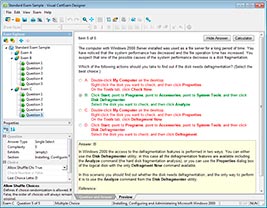
Use VCE Exam Simulator to open VCE files
HOW TO OPEN VCEX AND EXAM FILES
Use ProfExam Simulator to open VCEX and EXAM files

ProfExam at a 20% markdown
You have the opportunity to purchase ProfExam at a 20% reduced price
Get Now!